
Why AI-Generated Code Still Requires Human Debugging Skills
Software teams across the world are using artificial intelligence to write code faster than ever before. AI coding assistants can generate functions, automate repetitive tasks, suggest bug fixes, and even build small applications within seconds. Research from GitHub found that developers using AI-assisted coding tools completed some tasks significantly faster compared to developers working without assistance. At the same time, many engineers are discovering that speed does not always guarantee reliability.
Growing interest in AI-generated workflows has also changed how developers approach technical writing, optimization, and documentation. Resources such as the ChatGPT SEO book reflect how programmers, marketers, and technical teams are learning to adapt AI tools for broader digital strategies. Yet even with advanced automation, human debugging remains a critical skill because generated code can still contain flaws that software systems may fail to detect immediately.
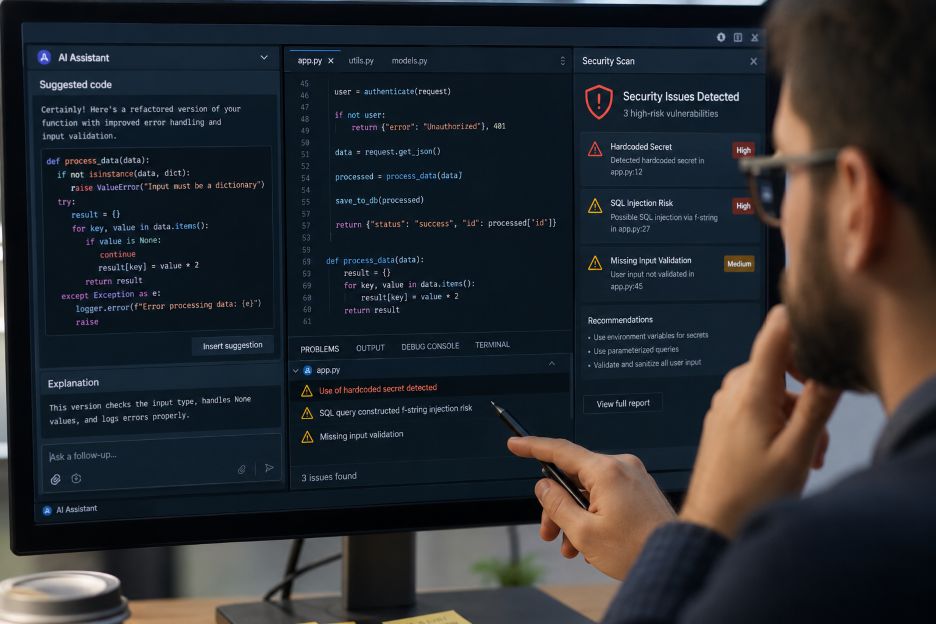
The Rapid Rise of AI Coding Assistants
AI-powered development tools have become common in modern software engineering. Products such as GitHub Copilot, OpenAI coding systems, and other machine learning assistants can analyze prompts and suggest blocks of usable code in real time. These systems are trained on large datasets that include open-source repositories, technical documents, and programming examples.
Data from Stack Overflow’s Developer Survey shows that many developers already use or plan to use AI tools during coding tasks. Teams often rely on them for boilerplate generation, syntax correction, documentation drafting, and repetitive backend operations. For businesses under pressure to release products quickly, AI-assisted development can reduce production time and improve workflow efficiency.
Despite these advantages, autogenerated code still reflects patterns learned from existing data. AI systems do not truly understand business logic, user behavior, or the long-term architecture of a project. They predict likely code sequences based on training information. That limitation creates room for subtle errors that may remain hidden until systems are tested in real-world conditions.
Why AI-Generated Code Can Introduce Problems
Many AI-generated outputs appear correct at first glance. The syntax may compile properly, and the application may even run without immediate failure. Problems often emerge later when software encounters unusual inputs, scaling challenges, or security threats. Developers continue studying common software code bugs because even advanced AI-generated solutions can still introduce hidden failures that are difficult to detect during early testing stages.
Hidden Logic Errors
Logic bugs are among the most difficult issues to detect because the software technically functions while still producing incorrect results. AI-generated code may misunderstand edge cases or create assumptions that do not align with project requirements.
Experts from Carnegie Mellon University note that AI systems can confidently generate inaccurate technical solutions that appear believable. A developer who relies too heavily on automation may miss flaws in calculations, database queries, or conditional statements.
For example, an AI assistant might generate a payment-processing function that works for normal transactions but fails during currency conversion or duplicate requests. These problems may remain invisible until customers experience real financial errors.
Security Vulnerabilities
Cybersecurity researchers have repeatedly warned that AI-generated code can contain unsafe programming practices. Studies published by Stanford University and other research institutions found that developers using AI suggestions sometimes produced less secure applications compared to developers writing code manually.
Security weaknesses may include:
- SQL injection vulnerabilities
- Weak authentication flows
- Improper input validation
- Unsafe API handling
- Exposed credentials in configuration files
AI models generate responses based on probability rather than security awareness. If insecure coding examples appear frequently in training data, those patterns may also appear in generated outputs. Human review becomes essential for identifying risks before deployment.
Outdated or Inefficient Solutions
AI tools can also recommend obsolete libraries, deprecated functions, or inefficient approaches. Software ecosystems change constantly. Frameworks evolve, security standards improve, and APIs become outdated.
Research from Google Cloud indicates that maintaining software quality requires continuous monitoring and developer oversight even when automation tools are involved. A generated solution that worked two years ago may introduce compatibility or maintenance problems today.
Human developers provide contextual judgment that AI systems currently lack. Experienced engineers can evaluate whether a recommendation fits modern standards, project scalability, and operational requirements.
The Human Side of Debugging
Debugging involves more than fixing syntax errors. Skilled developers analyze behavior patterns, investigate system interactions, and trace the root causes of failures across large environments. This process requires reasoning, intuition, and experience.
AI tools can assist with diagnostics, but they struggle with ambiguity. Real-world software systems often contain interconnected services, legacy infrastructure, third-party integrations, and undocumented workflows. Human engineers understand organizational goals and can evaluate trade-offs that extend beyond raw code generation.
Professional debugging typically includes:
- Reviewing logs and monitoring systems
- Testing edge cases and unusual scenarios
- Evaluating security implications
- Assessing performance bottlenecks
- Understanding user behavior patterns
- Identifying architecture-level issues
AI may accelerate portions of these tasks, but developers still need critical thinking skills to interpret the results accurately.
Why Technical Documentation Still Matters
Another challenge connected to AI-generated development is documentation quality. Many organizations now use AI systems to draft technical guides, onboarding documents, and API explanations. Automation can improve efficiency, especially for repetitive writing tasks.
However, technical documentation must remain accurate, structured, and understandable for both developers and end users. Poor documentation can create operational confusion even when the software itself works correctly.
Industry analysts from Gartner note that organizations adopting AI workflows increasingly require employees to verify generated content carefully. Technical writers and developers often review AI-produced materials line by line to confirm clarity, consistency, and factual correctness.
Documentation errors can lead to failed deployments, incorrect integrations, and security misconfigurations. Human reviewers help ensure that generated explanations match actual system behavior.
Balancing Automation With Oversight
AI-assisted development is unlikely to disappear. Automation tools continue to improve, and many engineers appreciate the productivity benefits they offer. The goal is not to reject AI-generated code entirely. Instead, modern software engineering increasingly focuses on responsible collaboration between humans and intelligent systems.
Many organizations are already adjusting internal practices to support this balance. Development teams use automated testing, peer reviews, security audits, and manual debugging to validate AI-generated outputs before production release.
Effective workflows often combine:
- AI-assisted code generation for repetitive tasks
- Human review for architecture and security
- Automated testing pipelines
- Manual debugging sessions
- Continuous monitoring after deployment
This layered approach helps reduce the risk of hidden failures while still allowing teams to benefit from automation speed.
Conclusion
AI coding assistants are reshaping software development by accelerating routine tasks and improving workflow efficiency. Research from GitHub, Google Cloud, and academic institutions shows that these tools can help developers move faster and handle larger workloads. Yet generated code still carries risks that machines alone cannot fully address.
Hidden logic flaws, security vulnerabilities, outdated methods, and documentation mistakes continue to require human judgment and debugging expertise. Skilled developers remain essential because software engineering depends on context, reasoning, and accountability.
Modern development is becoming less about choosing between humans and AI and more about understanding how both can work together effectively. Automation can support productivity, but long-term software quality still depends on careful oversight, testing, and critical thinking from experienced professionals.